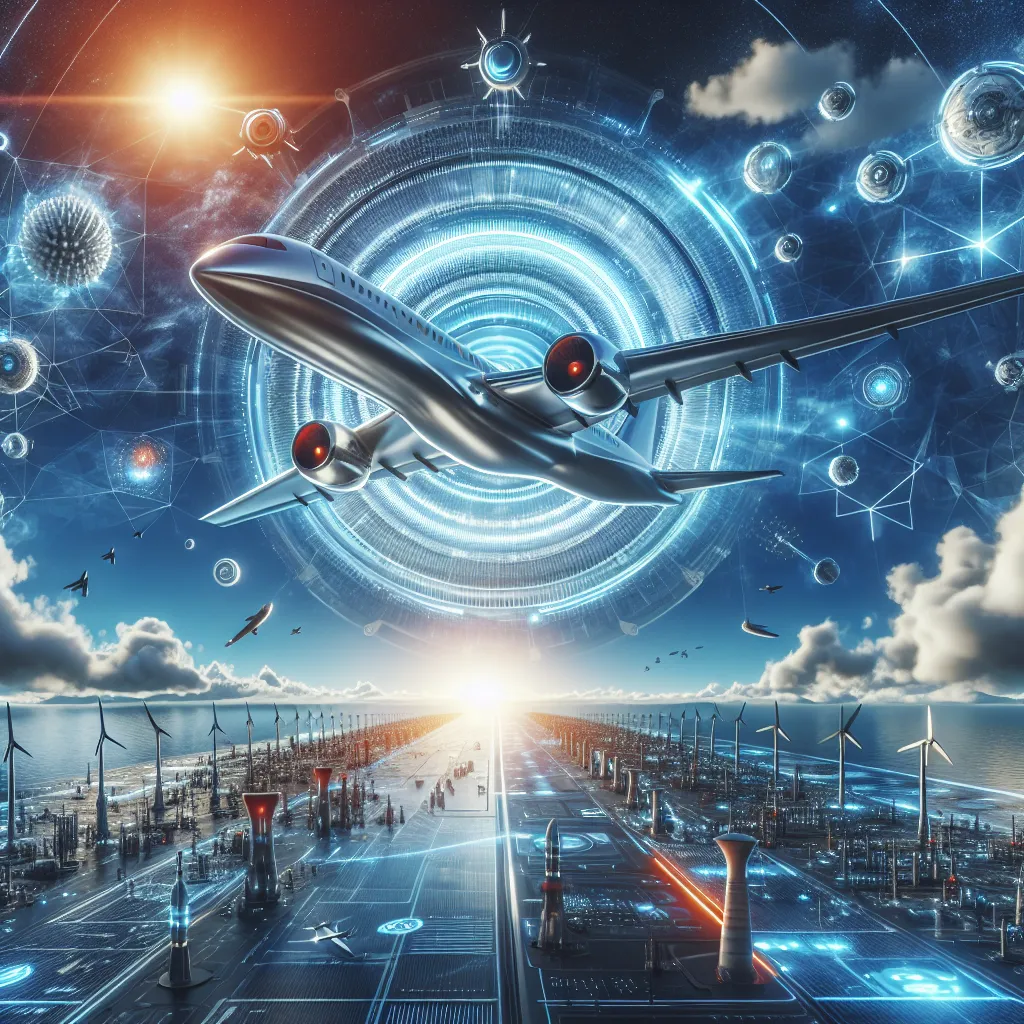
Title: The Mind-Blowing Science Behind Air Travel and Its Impending Revolution
Subheading: The Marvel of Flight
The magic of flight has always fascinated humanity. From the first feathered creatures to the latest jumbo jets, the ability to defy gravity and soar through the skies is nothing short of miraculous. But how does a 400-ton metal bird manage to fly? It’s all down to the clever application of scientific principles.
Airplanes don’t just overcome gravity; they harness it. The key to understanding this lies in two fundamental concepts: lift and thrust. Lift is the force that directly opposes the weight of the plane, pushing it upwards. Thrust is the force that propels the plane forward. Together, these forces enable an airplane to ascend and move through the air.
Subheading: The Science of Lift
Lift is generated by the shape of the airplane’s wings, specifically, the airfoil design. Wings are designed to be curved on the top and flatter on the bottom. When air flows over the wing, it moves faster over the curved top surface and slower beneath. This difference in speed creates a pressure differential – lower pressure on top and higher pressure beneath the wing. According to Bernoulli’s principle, this pressure difference generates lift, pushing the airplane upwards.
Subheading: The Power of Thrust
Thrust, on the other hand, is produced by the airplane’s engines. Jet engines work on the principle of action and reaction. They suck in large amounts of air at the front, compress it, mix it with fuel, and ignite it. The resulting explosion pushes the air out at the rear with great force. According to Newton’s third law, every action has an equal and opposite reaction. So, the force of the air rushing out backward propels the airplane forward.
Subheading: The Future of Air Travel
The science of flight is about to undergo a revolutionary change. We are on the brink of a new era in aviation, with the advent of electric and hybrid planes. These eco-friendly alternatives promise to reduce carbon emissions drastically, making air travel more sustainable.
Moreover, supersonic air travel is set to make a comeback, with several companies working on breaking the sound barrier once again. This could mean traveling from New York to London in just over three hours!
Subheading: Conclusion
The science of flight is a fascinating blend of physics, engineering, and a dash of magic. It’s a testament to human ingenuity that we’ve managed to understand and harness these principles to create the miracle of air travel. As we stand on the cusp of a new era in aviation, one can only marvel at what the future holds. From greener flights to supersonic speeds, the sky is truly the limit!